BLC Releases Community Report

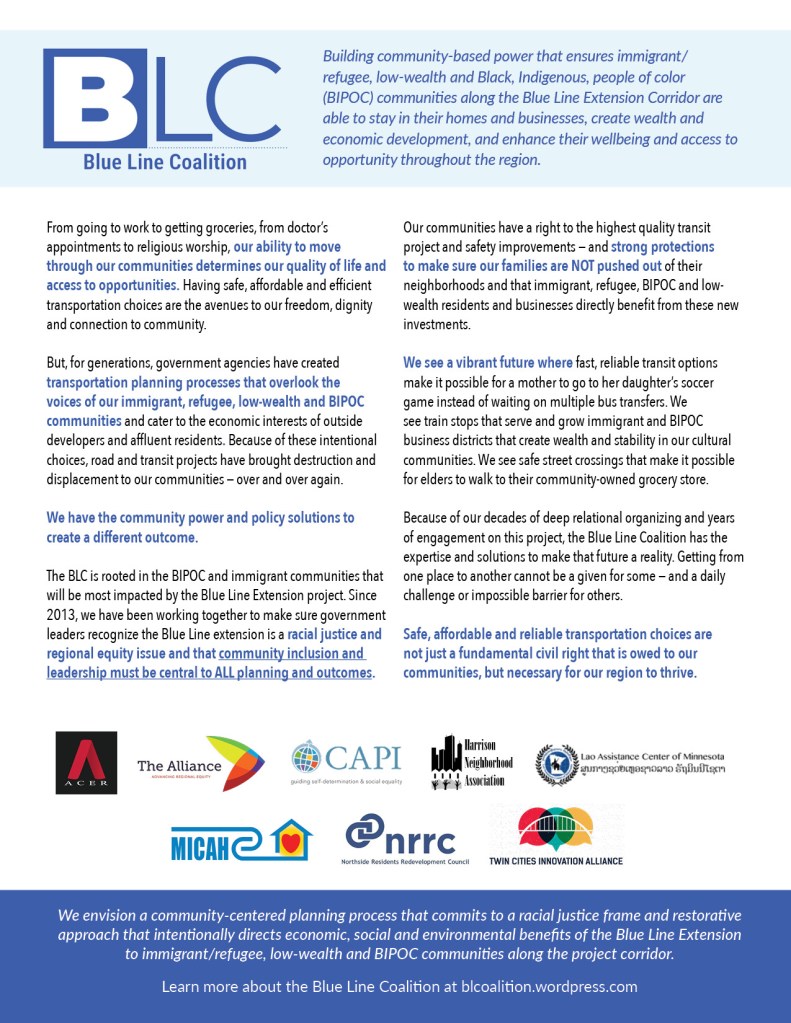
Since 2013, the Blue Line Coalition has been working together to ensure government leaders recognize that the Blue Line extension is a racial justice and regional equity issue and that community inclusion and leadership must be central to ALL planning and outcomes.

In coming months, key decisions will be made about the route of the light rail — and the outcomes will impact our neighborhoods and families for generations to come.

It is imperative that community concerns are not just affirmed but acted upon before route selection and construction begin.

Categories Uncategorized

BLC Responds to Draft Route Modification Report

January 25, 2022

Dear Governor Walz, Representative Omar, Commissioner Fernando, Commissioner Lunde, Chair Zelle, Mayor Frey, Council member Ellison, 

The Blue Line Coalition is rooted in the BIPOC and immigrant communities that will be most impacted by the Blue Line Extension project. Since 2013, we have been working together to make sure government leaders recognize the Blue Line extension is a racial justice and regional equity issue and that community inclusion and leadership must be central to ALL planning and outcomes.

After nearly a decade of planning, and more than $100 million spent, the Met Council and Hennepin County announced in August 2020 that they were abandoning the previous route for the Blue Line Light Rail Extension project. Since March of 2021, the project team has been engaging community members along the new proposed routes with the goal of identifying a “community supported route” by April 2022.

We believe in this project because our communities have a right to quality transit projects and safety improvements. We see a vibrant future where fast, reliable transit options make it possible for a mother to attend her daughter’s soccer game instead of waiting on multiple bus transfers. We see train stops that serve and grow immigrant and BIPOC business districts that create wealth and stability in our cultural communities. We see safe street crossings that allow elders to walk to their community-owned grocery store. 

But that requires a different planning approach — one that doesn’t aspire to equitable outcomes but takes the intentional steps at the appropriate time to achieve a different result. 

Because of our decades of deep relational organizing and years of engagement on this project, the Blue Line Coalition has the expertise and solutions to advance equitable outcomes. Together, BLC partners have successfully advocated for community-centered approaches, including advocating for adequate funding to resource community organizations in building trusting relationships with people who have vital expertise but have been blocked from participation due to cultural, language, financial or other barriers; extending the timeline for the selection of a new route to create space for authentic community engagement; and centering the adoption of anti-displacement policies as an essential aspect of the planning process. 

The “Draft Route Modification Report” only further underscores that displacement and gentrification are a broadly held and overwhelming concern of the communities most likely to be negatively impacted by development pressures and construction impacts from the project. While the report consistently elevates this concern our communities need more than recognition — they need action. We applaud the creation of the Anti-Displacement Work Group, but we must match the timelines of route selection and policy implementation to avoid yet another cycle of too-little too-late when it comes to protecting the interests and demands of our communities.  

The “Draft Route Modification Report” also highlights how some touted aspects of community engagement continue to leave us out. For instance, 51% of respondents to the online survey were white, while just 6% were Black and 3% Latinx — and the majority earned more than $60,000 per year. In addition, the community engagement cohort lacked representation from Spanish-speaking organizations and important aspects of engagement, like the online map, were created only in English, leaving out large segments of the community who speak other languages. This project should and must include the input of all stakeholders, but these disparities in certain types of engagement must be acknowledged, transparently, in weighing community input. 

And, more broadly, the community engagement process led by the project team continues to give only surface-level content to community members — for instance, visualizations of the proposed routes and stations — without  any concrete information about the pre construction, during construction or post construction impacts that are essential to informed decision making. And the impact of the pandemic and uprising cannot be overstated in its impact on community-based outreach efforts, given the serious health concerns and ongoing trauma in our communities.

There is an urgent need to redress the disinvestment and lack of transit options our neighborhoods have endured for generations. The project will only have an authentic “community-supported route” when the project team: 

  • Continues to invest resources to learn from community members who are Black, Immigrant, Indigenous, People of Color, and who are underrepresented in the current engagement efforts but disproportionately impacted by development pressures; this includes involuntary displacement as a result of the construction of the Blue Line Extension Project. The representation on the engagement efforts should represent the demographic of the corridor.
  • Before deciding on  a “Community Selected Route”, allows CURA’s Anti Displacement Workgroup initiative to conduct their proposed work plan. This plan would develop deep awareness and buy-in from decision makers who will be in charge of implementing and enforcing policy solutions that create protections for tenants, production of affordable housing, and preservation of older stock of housing which is currently more affordable than market rate.
  • Brings investment to the corridor and allows for the community to learn about those opportunities that can impact employment opportunities across the corridor, affordable housing, free fares for families and individuals who live on the blue line, business incubators, and other strategies that can help start the healing process in the area after decades of lack of investment and racist policies that have kept our communities from building wealth, power and influence. 

This project can and MUST be different than those before it. There is no doubt that many light rail lines in our region — and across the country — have pushed out current residents, immigrants and communities of color from their homes and businesses. This is the moment that we can choose to make bold decisions that make this project an example of justice and equity for cities across the nation. Our communities have the solutions and we urge you to not just hear and study our concerns but work with us to create lasting change.
Categories Uncategorized

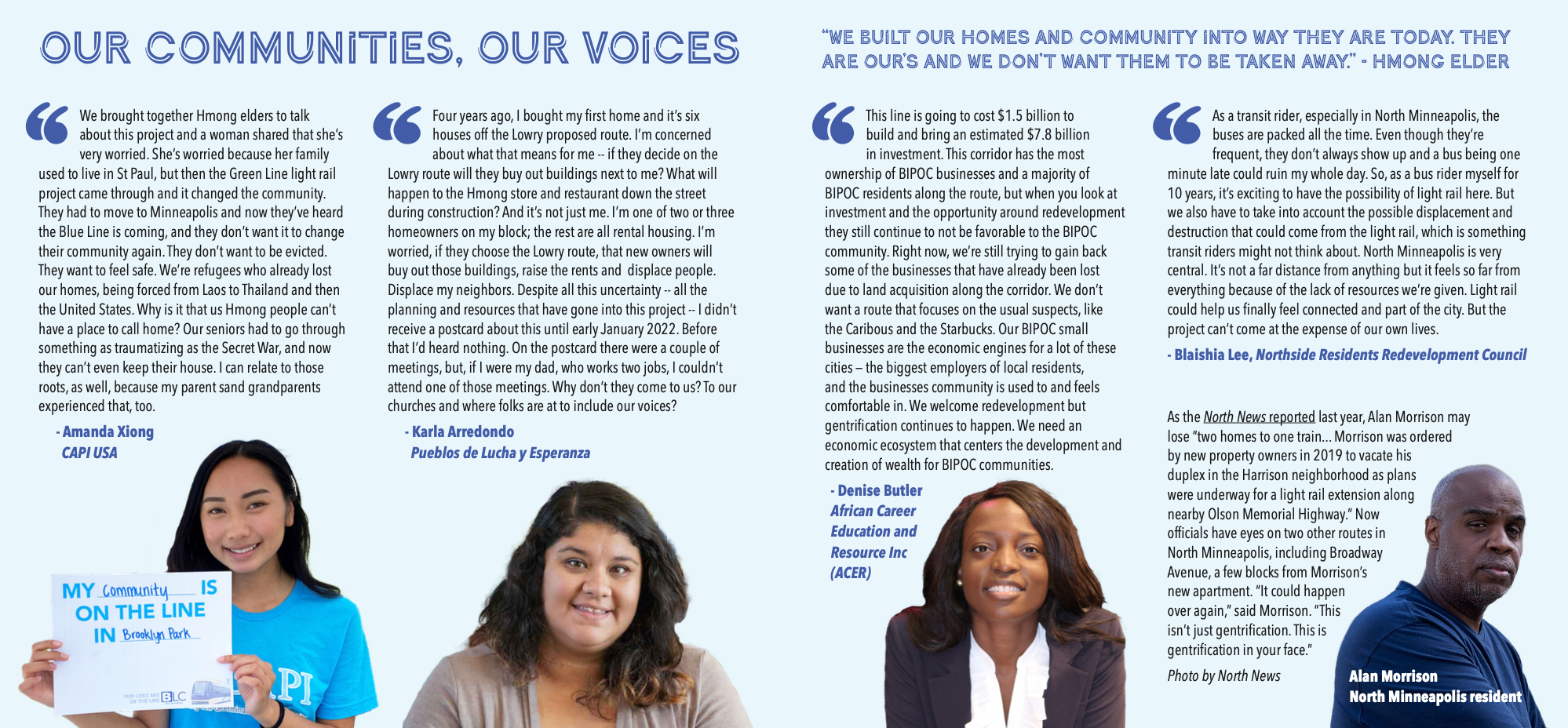
Our Lives Are on the Line- Community Update

From going to work to getting groceries, from doctor’s appointments to religious worship, our ability to move through our communities determines our quality of life and access to opportunities. Safe, affordable and efficient transportation choices are essential to our freedom, dignity and economic wellbeing. But, for generations, government agencies have created planning processes that do NOT center the voices of our immigrant, refugee, low-wealth and BIPOC communities.

As the Blue Line Extension project moves forward, we need government and institutional leaders to fully recognize that “Our Lives Are On the Line” — our homes and businesses, our places of worship and gathering spaces are the fabric of the communities along the Bottineau Corridor. With the exploration around a new route and development of anti-displacement policies, it is more important than ever that community-based organizations with deep trust and ties to the most directly impacted residents have a strong voice in this process. 

Since 2013, the Blue Line Coalition has been working together to make sure government leaders recognize the Blue Line extension is a racial justice and regional equity issue and that community inclusion and leadership must be central to ALL planning and outcomes. On July 13 we hosted a community update and conversation with BLC leaders to learn about our work, the progress of project and the implications for our communities! 

Download the one-pager for the event here — and watch the recording here!

Categories Uncategorized

Recap + Videos: Actualizing Equity in Transportation

From the freeway through Rondo to the absence of reliable transit in the northwest suburbs, generations of transportation investments have bulldozed or bypassed communities of color. But coalition organizing has put equity at the forefront of major transportation projects in the Twin Cities.

At the Alliance’s March 2021 event, Keith Baker (Reconnect Rondo), Denise Butler (African Career, Education and Resource Inc), Melvin Giles (Urban Farm & Growers Alliance) and Qannani Omar (Harrison Neighborhood Association) discussed approaches and strategies for equitable and restorative transportation projects.

Watch the full video recording

Watch clips from the speakers

Download the written recap

Categories Uncategorized

BLC Statement on Revised Routes Announcement: Make Equity and Inclusion Real

On March 11, the Metropolitan Council and Hennepin County introduced new Blue Line Extension LRT route options. The Blue Line Coalition — a coalition of community-based organizations representing marginalized populations along the proposed corridor — released the following statement in response to this announcement. 

Less than a year ago, in the wake of George Floyd’s murder, government institutions — from the Governor to Met Council to city leaders — made clear, public commitments to equity, justice and inclusion. But today, as our communities are re-traumatized by the Derek Chauvin trial and increased police presence across the Twin Cities, we learn yet again that the lives of our Black and Brown, Indigenous and Immigrant communities are left out of the critical conversations that have had and will have a deep and lasting impact on our lives.

Institutions at this table have not followed through on the promise to include the Blue Line Coalition as an authentic partner with a meaningful seat at the table. We are forced to react to discussions that have not included us or our communities — discussions that have resulted in a major step in this process. While we have attended hundreds of hours in meetings, we were given just five hours advance notice of the new proposed routes. This continues the generational history of transportation planning as an insidious tool of systemic racism. We can do better.

Since 2013, the Blue Line Coalition has partnered in good faith with Hennepin County and other groups to engage residents and stakeholders to ensure the Blue Line Extension project benefits rather than displace immigrant and BIPOC communities along the route. Our primary ask has been clear and consistent: For this project to be equitable, the voices of directly impacted communities must be centered. But, at every point along the process, we have been minimized or excluded.

Most notably, we are deeply discouraged by the absence of Olson Memorial Highway among the route options. For years, Harrison Neighborhood Association and its residents have dedicated countless hours to providing input and articulating a vision for a transit line that will ultimately bypass their community. It is now clear that residents were asked to design their own displacement. While project leaders assured us that the coming light rail would bring street safety improvements and affordable housing resources, it has only resulted in zoning changes for new development and skyrocketing rents and property values. We urged leaders that anti-displacement policies couldn’t wait until construction — and we were right. Now, many of the residents who participated in the initial community engagement have been denied the opportunity to benefit from any transit improvements in North Minneapolis because they have been pushed out.

As a coalition, we stand in solidarity with Harrison Neighborhood Association and its residents, while also maintaining a sense of urgency to move forward and bring needed transportation options to our communities. In addition to addressing the harms to Harrison and other Near North neighborhoods, we strongly urge Hennepin County and Met Council to:

  • Provide transparency and accountability around the funds allocated to facilitate negotiations with BNSF.
  • Revise Hennepin County’s contracting process and increase the funding for community-based organizations to do the essential engagement to reach directly impacted residents and actualize equity in the process and outcomes of this project. The resources allocated for community engagement are dramatically less than the real cost and scope of organizing and the complexity and length of the contracting process is a significant barrier.
  • Actively engage with us in advancing policies for equitable housing and affordable commercial spaces to ensure our communities are able to stay in their homes, thrive in their businesses and save hundreds of hours wasted by a poorly designed transit system to spend with their families and loved ones.
  • Prioritize anti-displacement policies at the forefront in all levels of decision-making regarding this project. While government entities have had years to plan and implement a light rail extension that properly addresses the impacts of development and provide strong anti-displacement policies that center current residents in the community, largely BIPOC residents, there has been little to no progress.
  • Commit to true inclusion that shares information with our coalition as early as possible in any decision-making or public announcements to allow our organizational members and the constituencies we represent the opportunity to review, process and respond in a timeframe that respects our expertise and honors the many competing issues in our communities. The recent announcement of the possible new routes is a present example of the continuous pattern of interactions in which there is a lack of intentionality to obtain equitable outcomes and our coalition is made to react rather than participate.
  • Act on our shared understanding of the tremendous potential impacts — both positive and negative — of the development of this line, specifically learning from previous lessons, including the experiences of the Harrison and Near-North neighborhoods. The immense equity implications of this project necessitate intentionality and accountability in all aspects of the process. We will not ask our communities to design their own displacement.

For generations, highway projects have decimated Black business districts to spare white neighborhoods. Transit projects have skipped over communities of color to whisk white commuters to downtown job centers. The decisions about the Blue Line extension will further entrench this pattern by promoting displacement or we can reimagine the public process to support success and vitality of our immigrant and BIPOC communities.

As we said in August, we are disappointed, but we are not disheartened. We know our voices have shifted the narrative and our efforts have set a clear course for equitable engagement. We want to walk together with all of you in this journey to bring light rail to the North Minneapolis and the northwest suburbs but we need your trust and cooperation to shift the long legacy of transportation planning as a driver of destruction and displacement in our communities.

By intentionally working with us to address what has been holding us back we can unleash the economic potential of people who live financially burdened, one unexpected expense away from eviction. Together, we can give back hundreds of hours spent on poorly designed transit to families or individuals who can choose to invest that time in themselves, their families and their communities. With our communities at the center, we can — and must — transform transportation planning into a tool for inclusion and equity. The time to act is now.

Categories Uncategorized

BLC to Governor, Met Council and Hennepin County: Ensure Blue Line Extension LRT benefits our communities

On August 12, the Blue Line Coalition sent the following set of recommendations regarding the alignment and construction of the Blue Line extension project to key policy leaders. Read the letter below or download the PDF. Read the BLC’s public statement here.

Dear Governor Walz, Metropolitan Council Chair Zelle, and Hennepin County Board,

The Blue Line Coalition is a coalition of organizations in relationship with immigrant and Black communities living in North Minneapolis and the Northwest suburbs in the Bottineau corridor. We stand together to call upon our elected officials to ensure the METRO Blue Line Extension LRT gets built in ways which create the equitable development, economic opportunities and access this line has the capacity to bring. It is vitally important to the health of our communities and, consequently, to the health of our entire region that:

  • The METRO Blue Line Extension gets built to connect Northwest suburbs to downtown Minneapolis in the most timely fashion, but without inferior quality due to haste.
  • The mode of this line remains light rail transit.
  • This project does not lose its place in line for federal New Starts dollars.
  • All options are kept on the table to move forward with the current alignment, while alternative alignments are evaluated.

As you know, for generations, transportation has been misused as a tool for systemic racism, letting highway projects decimate Black business districts to spare white neighborhoods. Previous transit projects prioritized white commuters while skipping over communities of color on their way to downtown job centers.

However, starting in 2013, the Blue Line Coalition partnered with Hennepin County to engage communities along the current alignment, whose lives are integrally tied to that alignment in their housing, jobs and livelihoods. We had a shared goal, to ensure this METRO Blue Line Extension is planned and implemented in an inclusive and equitable way, and we rose to the challenge of this shared goal. The BLC put forward visions of equitable development along the corridor in our Equitable Development Principles & ScorecardHousing Policy Platform, and Station Area Plans.

Last week, like so many others, we were surprised and frustrated by the announcement to abandon negotiations with BNSF Railway on the route. Along with elected leaders, in the corridor cities, we have a very strong preference for this project to proceed as light rail. If a new route is necessary, the start and end points must remain the same to connect our communities and keep our place in line for federal funding. But, more than an allegiance to any one alignment, we are dedicated to advancing critical transit options that are the backbone of racial and regional equity.

Despite our disappointment, our coalition sees the additional possible opportunities in this announcement for a second beginning in which we can be creative and use the lessons, tools and information we’ve acquired over the seven years working together with Hennepin County to make this light rail transit project a reality.

We look forward to building upon this innovation by executing a plan that is intentional about benefiting all communities of color and implementing tools that address oppressive systemic issues. The opportunity exists to explore additional options, to lead with inclusivity, and to work together towards an extension line project that best meets the needs and dreams of our communities.

Thank you for your commitment to One Minnesota and the continued fight against systemic issues that keep our communities of color excluded from developing wealth, and segregated from opportunities in our region.

Categories Uncategorized

BLC statement: “Whatever the route, community must guide the direction of Bottineau Blue Line project”

Statement from the Blue Line Coalition in response to Hennepin County and Met Council abandoning route for Bottineau Blue Line light rail. 

For generations, transportation planning has been an insidious tool of systemic racism. Highway projects have decimated Black business districts to spare white neighborhoods. Transit projects have skipped over communities of color to whisk white commuters to downtown job centers.

So, in 2013, when the planning around the METRO Blue Line Extension began, we were ready. The creation of the Blue Line Coalition brought together powerful organizations with deep connections to and trust within the immigrant, low-wealth and Black, Indigenous and People of Color (BIPOC) communities to ensure that those most impacted by this massive infrastructure investment had a strong voice in the process.

Last week, like so many others, we were frustrated by the announcement to abandon negotiations with BNSF Railway on the route that has been in development for nearly a decade. But we believe the time to move forward is now — and that movement must center the voices and needs of immigrant and BIPOC communities who have been bypassed or bulldozed by transportation projects in the past.

For years, we have played a key partnership role in the Blue Line extension project. We have provided countless hours of assistance to Hennepin County staff and corridor cities to incorporate equity into engagement practices, branding materials, and station area planning. We have educated consultants and consulted on marketing strategies. We have worked with the public and private sector to guide their use of the BLC Equitable Development Scorecard, which provides a template for investment that elevates rather than excludes our communities. We have shared proven and actionable policy ideas to ensure development without displacement in our Housing Policy Platform.

Along with elected leaders in the corridor cities, we feel have a very strong preference for this project must to proceed as light rail. If a new route is necessary, the start and end points must remain the same to connect our communities and keep our place in line for federal funding. But, more than an allegiance to any one alignment, we are dedicated to advancing critical transit options that are the backbone of racial and regional equity.

While we are disappointed, we are not disheartened. We know our voices have shifted the narrative and our efforts have set a clear course for equitable engagement. Through all the uncertainty and delays, the BLC has been onboard, cultivating community input and buy-in that can lay the tracks for whatever comes next.

As evidenced in our recent letter of support with elected officials in corridor cities, we are no longer alone in naming transportation inequities as systemic racism. In the wake of George Floyd’s murder and the devastating impact of COVID-19 in communities of color, Hennepin County and Met Council Chair Charlie Zelle have also pledged their commitment to racial equity. As we so often hear in the streets: Justice delayed is justice denied. Now is the time for action.

Like the highways that tore through our neighborhoods, this project will impact generations to come. The decisions about the Blue Line extension will intentionally ignore or actively create the critical transit connections necessary for the success and vitality of our immigrant and BIPOC communities. With our communities at the center, we can — and must — transform transportation planning into a tool for inclusion and equity.

Categories Uncategorized

Actualizing Equity 2020: Transit

The COVID-19 pandemic has brought into the spotlight the role of “essential” workers — who are disproportionately low-wealth, immigrant and communities of color —  and revealed the racialized and ableist gaps in the essential services those workers need to protect their health and meet their daily needs — including safe, reliable public transit. The Alliance’s April 2020 Actualizing Equity event, facilitated by Ricardo Perez, BLC coalition organizer, explored: how do we proactively combat the current and coming attacks on our already dramatically under-funded and inequitable transit system while also boldly asserting the sweeping changes necessary to prioritize the needs of essential workers, people with disabilities and communities of color not just now, but far beyond this current crisis?

Speakers included

  • Amity Foster, Twin Cities Transit Riders Union
  • Charles Frempong-Longdon, Sierra Club North Star Chapter
  • Finn McGarrity, Move Minnesota
  • Martin Hernandez, West Side Community Organization, formerly of LA Bus Riders Union
  • Nikki Villavicencio, disability rights activist and ADAPT member

Click here for the recap resource!

Categories Uncategorized

Actualizing Equity 2019: Equitable Transit-Oriented Development

Past exclusionary transportation policies moved people through neighborhoods rather than throughout neighborhoods, destroying rather than building upon the assets of African American and other communities of color. Development surrounding light rail and bus rapid transit can reverse this — if tailored to the needs of people of color, indigenous, immigrant and low-income communities who are disproportionately dependent on public transit.

The Alliance’s May 2019 Actualizing Equity event explored how organizers have mobilized — and are mobilizing — to integrate affordable housing, health, economic development and other equity issues into the visions and implementation of coming transit investments. We heard from Denise Butler, Program Manager for African Career, Education and Resource Inc (BLC member); Nestor Garcia, Community Outreach Director for the Harrison Neighborhood Association (BLC member); and Kenya McKnight, Founder and President of the Black Women’s Wealth Initiative — with facilitation from Avi Viswanathan, Program Director for the Nexus Community Engagement Institute at Nexus Community Partners.

Download the recap resource!

Categories Uncategorized