News

Community leaders rally outside Metro Transit as local officials cancel meeting, delay funds to fight displacement

Over a year after the MN State legislature allocated $10M for investments along the route of the Blue Line Extension light rail line, community leaders are calling on Hennepin County and Met Council to follow through on commitments to prevent displacement of local residents and businesses, especially the Black, Indigenous, and communities of color in North Minneapolis, Brooklyn Park, and Brooklyn Center who will be most impacted by rising property values and transit disruptions.

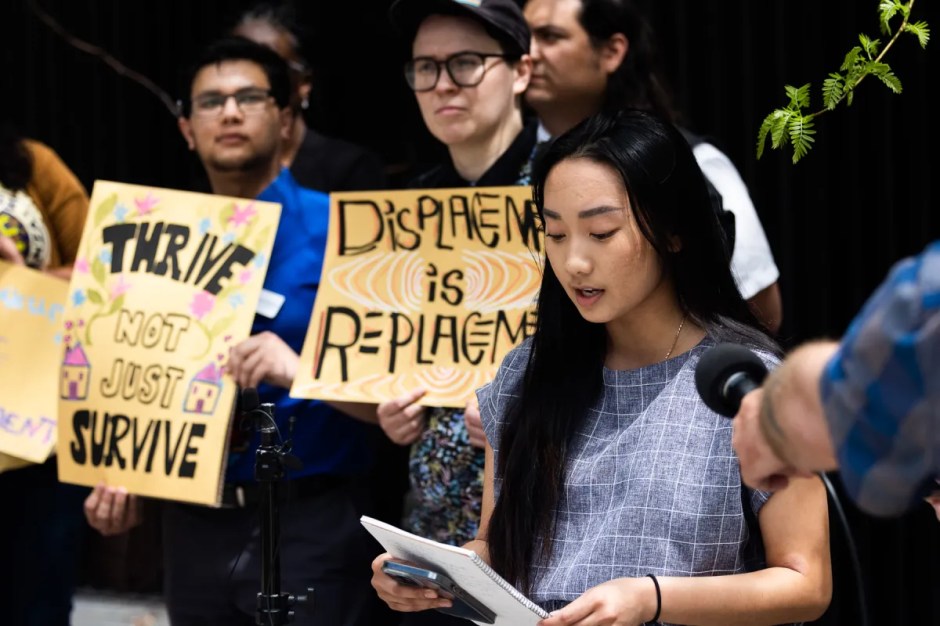
On August 7th, 2025, the Blue Line Coalition held a rally and press conference outside of Metro Transit offices.  Watch a full video of the press conference here

Anndrea Young speaks at Blue Line Coalition action outside Metro Transit Minneapolis

Anndrea Young, Executive Director of the Heritage Park Neighborhood Association, speaks at a press conference outside of Metro Transit on august 7, 2025. 

Key points

  • Funding Delayed: Local businesses, organizations, homeowners, and renters across the corridor of the METRO Blue Line Extension (BLE) Project have been waiting to apply for funds from the Antidisplacement Community Prosperity Program (ACPP). Just as applications were going to begin to be accepted in July, Hennepin County revealed previously unmentioned bureaucratic hurdles that would make it harder for communities to access support. For example, instead of providing funds directly, Hennepin County announced they would only consider reimbursing applicants, effectively withholding the capital needed for projects to move forward.
  • Racial equity data deleted: In May, Met Council published the Blue Line Extension project’s Supplemental Final Environmental Impact Statement. The chapter on environmental justice, which includes data on the disproportionate impact on Black, Indigenous, and communities of color, was removed– despite a long process of community engagement, leaving only a verbal commitment from Met Council to follow through on equity goals.
  • Community demands agencies honor their commitments: On August 7th, the Met Council canceled a meeting of the Corridor Management Committee, where community members had hoped to find answers on how environmental justice impacts will be mitigated and how communities can access antidisplacement funds. “Hennepin County and the Met Council didn’t show up today, but we did,” said Ricardo Perez, an organizer with the Blue Line Coalition, standing alongside impacted community members. “We’re here to demand that Hennepin County remove unnecessary barriers to accessing antidisplacement funds. We call on the Met Council to commit to taking a proactive role in addressing displacement, starting with the release of a local addendum to the Environmental Impact Study that includes omitted data on BIPOC displacement.”

Ricardo Perez speaks at Blue Line Coalition action outside Metro Transit Minneapolis

Ricardo Perez, Coalition Organizer at The Alliance for Metropolitan Stability, speaks at the press conference and rally alongside Blue Line Coalition members.

Community leaders speak out

“We have worked with the County for over a year to build a mutual understanding of how to create an equitable funding model,” said Ricardo Perez, chair of the ACPP Board and organizer with the Blue Line Coalition (pictured, above). “The County’s requirements come at a cost, and that cost will be paid by those most vulnerable to displacement, neighbors and businesses who have lived in the corridor for generations, communities who make this area vibrant and desirable for development to occur: Black, African and African American, Asian, and immigrant people of color.”

“Heritage Park is not just another stop on a transit map. It is home. It is the heart of North Minneapolis a neighborhood of legacy residents who have stayed through disinvestment, through demolition, and through broken promises. These residents have roots here, history here, and they deserve more than continued displacement. What’s especially painful is that $10 million dollars were allocated through community advocacy by our state legislature, yet the funds have not been disbursed into the community. The delay in releasing those funds isn’t just a policy issue. It’s a human one. It’s putting real pressure on families pushing them closer to the edge of displacement every day,” said Anndrea Young, Executive Director of the Heritage Park Neighborhood Association. Read her full statement here

“Right now, we’re still trying to gain back some of the businesses that have already been lost due to land acquisition along the light rail corridor. Our small businesses run by Black, Indigenous, and people of color are the economic engines for a lot of these cities,” said Denise Butler, Associate director of African Career, Education and Resource (ACER). “We welcome redevelopment but gentrification continues to happen. We need an economic ecosystem that centers the development and creation of wealth for BIPOC communities.” 

“In light of the displacement that has already occurred, along with the potential for increased displacement before construction starts, the project should halt all steps towards construction until all anti-displacement measures as well as adequate funding for those measures is in place,” said Martine Smaller, Executive Director of the Northside Residents Redevelopment Council.


Media coverage
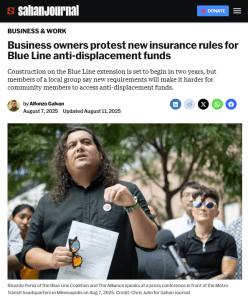
Business owners protest new insurance rules for Blue Line anti-displacement fundsSahan Journal

Hennepin County and Met Council Accused of Backtracking on Equity CommitmentsBlck Press

Metro Transit Blue Line Extension protest over displacement FearsFox9

Community members demanding funding for displacement related to Blue Line ExtensionKSTP

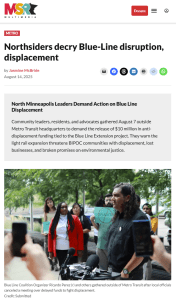
Northsiders decry Blue-Line disruption, displacementMinnesota Spokesman Recorder

Rally and press conference

Tell Met Council and Hennepin County:

Honor your commitments to our communities!

Funding antidisplacement can’t wait!

Our communities are on the line.

We’ve been fighting for over a decade to prevent displacement– now is the time for elected leaders and planning agencies to honor their commitments and release promised funding.

The Blue Line Coalition calls on community members across the Twin Cities to stand up for our right to build thriving neighborhoods and businesses.

Rally and press conference

Thursday, August 7th, 2025 1:00PM, Metro Transit Headquarters

Join the antidisplacement fund review panel

Check out this opportunity to help shape antidisplacement efforts along the Blue Line Extension (BLE) corridor. Blue Line Coalition partners and supporters are encouraged to apply, and spread the word about this opportunity.

The Anti-displacement Community Prosperity Program (ACPP) Board is developing a Request for Proposals (RFP) to distribute $10 Million in funds appropriated by the Legislature to mitigate displacement caused by the Blue Line Extension. The Board seeks RFP review panelists to review proposals against evaluation criteria established by the Board.

Get involved

  • Ideal review panelists include residents and business owners in the BLE corridor, including those with expertise in real estate development or financing, housing, small business supports, and workforce.
  • The time commitment is approximately 10-15 hours beginning Summer 2025, and compensation is available in the form of a $50 prepaid debit card for each day of service.
  • In the event a panelist applies for ACPP funding or is involved with an organization that applies, the panelist will be ineligible to participate in the review of that application.

Contact Eric Gustafson, eric.gustafson@hennepin.us to learn more or apply to the review panel.


Background

The community-led ACPP Board includes residents and business owners, people with lived experience of displacement, people from the nonprofit and philanthropic communities, and representatives of local government agencies.

The Blue Line Coalition has been working with community and government partners for over 10 years to develop anti-displacement commitments and strategies. Members of the BLC sit on the ACPP Board.

Next Stop: Action for Our Communities


The Black, Indigenous, immigrant and people of color communities living along the Blue Line Light Rail Extension deserve public and private investment — on our own terms. Working with community, the Blue Line Coalition has secured big wins that will help ensure this billion-dollar investment brings big benefits for our people.

Read more in our 2024 Community Report!

For too long, residents of North Minneapolis and the northwest suburbs have been ignored or harmed by transportation projects. Olson Memorial Highway destroyed a thriving Black business district, leaving an unsafe scar that divides our community to this day. Past light rail projects have spiked housing costs and pushed out Black, Indigenous, immigrant and people of color (BIPOC) businesses.

That’s why the Blue Line Extension must be different from past transit projects. We need a transformative process that centers community voices and puts people first. 

When we come together across race and place, have the power to make change. Because of our organizing, project leaders have made anti-displacement a top priority and worked with community to identify key policy and funding recommendations to make sure BIPOC residents and businesses along the corridor are able to stay, grow and thrive. Because of our advocacy, state lawmakers established a Community Prosperity Fund with $10 million to protect our people and businesses. 

This year is a critical moment for project leaders to not just listen but act on the leadership our communities have provided — and put policies and funding in place to earn community consent to begin construction.

Learn more about our efforts to tell project officials that “It’s not about the train; it’s about the PEOPLE!” in our 2024 Community Report!

Blue Line Coalition Calls for Adoption of Anti-Displacement Working Group Report


For more than a decade, community members and organizations along the Blue Line Extension Project have called for government leaders to ensure that the immigrant communities and communities of color along the corridor directly benefit from the multi-billion-dollar public investment. 

Because of this advocacy, project leaders established and funded a first-of-its-kind Anti-Displacement Working Group specifically focused on listening to community concerns and putting forward tangible policy recommendations to prevent people from being pushed out of their homes, businesses and neighborhoods so they can thrive in the places they choose to live, work and create community.

On Thursday, more than a dozen organizations united to call on project leaders to officially adopt the recommendations of this working group at the Corridor Management Committee meeting as a first and crucial step toward an accountable and equitable process that can make the Blue Line Extension Project a national model for community-centered transit planning.  

“This represents 18 months of hard work that Blue Line Coalition was a part of,” said Ricardo Perez, Coalition Organizer at The Alliance. “Today is an historic day where we will learn more about this plan to address displacement on the corridor.”

“Our people live, work and own businesses from Minneapolis all the way up to Brooklyn Park,” said Karla Arredondo, Executive Director at Pueblos de Lucha y Esperanza. “Our community has given so much vibrance to our cities but we’ve seen alarming data that shows a disproportionate lack of engagement with the Latinx community. We must continue to invest in connecting with our community so the development project does not displace us but helps us thrive. Our esperanza — our hope — is that cities adopt all recommendations brought forward in this report and secure the sustainable, ongoing funding needed to create an abundance for our families. We hope project leaders can see that this is our neighborhood and we are here to stay.”

“It is unacceptable to move forward without first conducting health and economic impact studies, thorough community engagement and implement policies and protections that make sure this project doesn’t continue a long history of transportation projects that have caused displacement, division and divestment in communities of color,” said Alex Burns, Advocacy and Policy Manager at Our Streets Minneapolis. “We stand alongside members of the BLC in calling on Hennepin County and project leaders to fully adopt the anti-displacement recommendations… and fully fund implementation before, during and after construction.”

“Many of individuals we serve endure poor-quality living conditions and anti-displacement can generate millions of dollars to secure affordable housing in our communities,” said Tambryanna Williams, Public Policy Manager at CAPI USA. “[These anti-displacement recommendations can] ensure that residents benefit from this expanded opportunity and prevent a repeat of I-94 in the Rondo community.”

“The community has been speaking for over 13 years,” said Nelima Sitati-Munene, Executive Director of African Career, Education and Resource Inc (ACER). “We are in support of the line but we know that a focus on infrastructure in itself does not address the needs of the community. We are advocating for a people-centered development strategy; one that is going to uplift the lives of our community members and prevent them from being displaced. Brooklyn Park has the most stations on the line, with five possible stations. It also has the most developable land along the line. What we’d like to see is investment to get our residents capital-ready to take advantage of the development so we are not left behind. The Blue Line Extension is also the most diverse line in terms of racial and economic diversity and it is also the most youthful line. This is the most significant investment we will see in our city in our lifetime so we want to make sure that it is done right. We want this line to serve as an example of what can happen in our region when we do development that is centered around the people who need it most.”

“We have to ask is it worth it?” said Amanda Xiong, a 21-year-old organizer from Brooklyn Park and member of the Anti-Displacement Working Group. “We aren’t opposed to the train but we are opposed to injustice and displacement. And in our history we have seen communities of color constantly rolled over and looked over — and we don’t want to let that happen again. So let’s change that!”

Read coverage of the press conference in Sahan Journal!

Actualizing Equity in Transit: Our Vision of Abundance

Historically in the Twin Cities, transit development has led to the systemic displacement of and under-investment in Black, immigrant and local community members and businesses.

Blue Line Coalition is advocating for transformative shifts in transit development by leading with an abundance mindset. We know that community has the abundance of expertise to know the solutions for a successful transit line and corridor, and there is an abundance of resources to realize those solutions.

At the Actualizing Equity event hosted by the Alliance this month, the Blue Line Coalition discussed: What elements compose such a vibrant community? And what it would take to materialize the collective outcomes our communities seek?


“It’s all about celebrating the diversity of North Minneapolis. It’s about building business and having a good time. I’ve always wanted to make sure that this extended Blue Line is about the people. That it has all the amenities, all the goodies that we deserved in this community. I’ve been talking about a party train with a disco ball and slot machines on it. I want to see vibrating, massage chairs and edible plants on the platforms. Let’s have some fun with this. Let’s get the people what they want.”Candy Bakion, Metropolitan Interfaith Council on Affordable Housing (MICAH) and Heritage Park resident

“I want to feel like I belong here. That this is my train. Like there’s a mural on the building of Sammy’s Avenue Eatery of the Virgin of Guadalupe. That just makes me feel at home. And I want the train to reflect all of us, to make the community feel like home. For that to happen, we need a pool of funding for all residents and businesses, regardless of immigration status, to stay in their home and their communities with access to assistance throughout the project.”  –Karla Arredondo, Pueblos de Lucha y Esperanza

“The neighborhood would be more accessible. It’ll be more healthy. It’ll be more safe, whether you’re walking, or riding your bike. I like to be on my bike or my roller skates. And it would also have a very strong youth presence and  influence and  ownership. And young people wouldn’t just have ownership of the things but in the ideas, in the plan, in this vision and in the strategy and the execution. Then it will really feel like this is their home as well and they get to create the world they’re going to want to live in.” –Felicia Perry, Partnership in Property Commercial Land Trust

“Having walkable, accessible neighborhoods and amenities is super important. The areas of the Twin Cities that benefited from racial covenants are really well developed. They have access to schools, pharmacies, clinics, grocery stores, and the traffic noise is little to non-existent. People live near lakes. They’ve enjoyed opportunities for generational wealth. So a successful outcome here is neighborhoods constructed around communities’ imagination and ideation for the kinds of things that they’d like to see.” José A. Zayas Caban, Our Streets Minneapolis

Watch the recording or download the full recap!

Comments on the Scope of the Supplemental Environmental Impact Study

Dear Blue Line Extension Leaders and Environmental Compliance Lead Ms Neha Damle:

The Blue Line Coalition includes 13 organizations with roots in communities that live, work, go to school across the corridor of the Blue Line extension project. Our advocacy aims to ensure the opportunity that comes with building a train through our communities does not harm us, but materializes the benefits and impacts that we envision collectively as a community.

This letter is to provide comments on the publication of the scope for the supplemental environmental impact study (SEIS) on the blue line extension project. The SEIS is an opportunity to ensure that our collective efforts between the project team, elected officials, and community to address anti-displacement before, during and after construction become a reality.

To that end, the scope of the study must be expanded to include the following:

  • Understands the social and community impact that the development of the train will have across the corridor before, during and after construction — specifically looking at the impacts of the global pandemic of COVID-19 and the civil unrest that impacted the corridor in 2020.
  • Covers the mitigation of previous harms made by the route modification — such as impacts to the Harrison Neighborhood, the Heritage Park Neighborhoods — by the design of the blue line extension project.
  • Studies the business, housing and cultural displacement as a result of the construction, design of the blue line extension project; and mitigation strategies that can be applied  before, during and after construction such as technical assistance and forgivable grants
  • Includes mitigation strategies that invest in neighborhoods that have been historically underinvested and disproportionately impacted by racist planning processes and policies; not deconcentrating areas of poverty.

Thank you for your time,

Ricardo Perez
Blue Line Coalition/The Alliance

Denise Butler
African Career, Education & Resources Inc. (ACER)

Ivory Taylor
Housing Justice Center

Anida Phomsendy 
Lao Center of Minnesota 

Christi Sullivan
Heritage Park Neighborhood Association

Karla Arredondo-Payan
Pueblos De Lucha Y Esperanza

AsaleSol Young
Urban Homeworks

Kenzie O’Keefe
Pillsbury United Communities

Sue Watlov Phillips
Metropolitan Interfaith Council on Affordable Housing

BLC votes NO on route modification

The BLC is part of the Corridor Management Committee (CMC) — a voting body that advises the Metropolitan Council and Hennepin County on the design and construction the Blue Line extension project. Most projects like this have a CMC — but this one is different. Thanks to years of advocacy, BLC partners (with the support of then Rep. Keith Ellison) secured two seats at this table, which is otherwise composed of mayors and senior planners from the corridor cities. Our inclusion intentionally makes room for underrepresented communities who are disproportionately impacted by the construction of the Blue Line extension project.

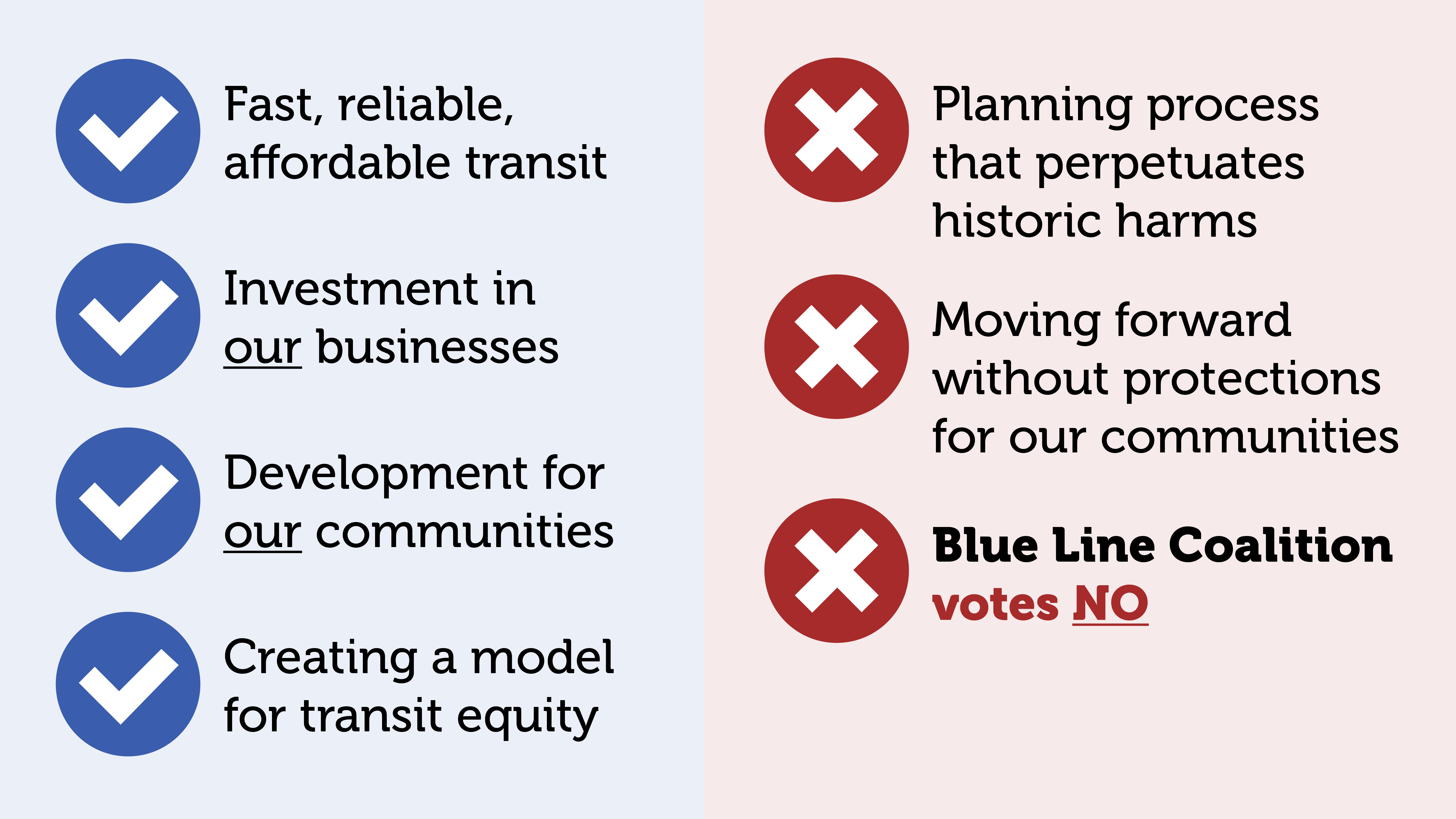
On June 9, 2022, the CMC voted on the recommended modified route. BLC took a strong stance and voted NO. This is not because we are against transit development. It is because we are a coalition of organizations that deeply care about and love our communities and demand that patterns of harm are broken and history is made — with us and for us.

This is what we shared with the committee when we voted NO:

We, the Blue Line Coalition, are disappointed at the lack of intentionality to align the timing of the route modification to the efforts to ensure that Black, immigrant, and people of color communities benefit directly from the construction of this transit project — rather than paying the ultimate price: being displaced.

It is disappointing that all we have learned and seen at the city, county and regional level over the past several years was not enough to compel action on anti-displacement before choosing a new route for the Blue Line extension project. 

Our collective memory has not changed. We remember Rondo. We remember Olson Memorial Highway. We remember all of those community members and families who have been disproportionately negatively impacted by transportation projects funded by our tax dollars.

We continue to look for ways to support this project. We welcome investment and the ability to create pathways for our micro and small businesses to move from renters to owners. We welcome safe, reliable transportation for our community members, who are transit dependent and currently unable to take their kids out on the weekend to visit the cities where we live and work. We strongly believe that our community deserves nice things, like a grocery store where we can buy healthy foods to cook meals for our families.

But, because of the enormous respect and love that our communities deserve, we must stay true to our principles. We cannot support a project that is being built in the name of equity, when we still do not know how much money will be allocated to address the inequities that have shaped our neighborhoods for generations. So we are voting No.

We do remain hopeful that change is possible. Through our collective efforts we were able to produce many comments during the commenting period for the route modification report that agreed we can do better on the Blue Line extension project. We appreciate and support the efforts of Minneapolis City Councilmember Jeremiah Ellison, Hennepin County Commissioners Irene Fernando and Jeff Lunde, Representative Ilhan Omar, and Senator Tina Smith. However, every day that passes without cohesive and concrete efforts by all levels of government, we miss the opportunity to build a different kind of legacy — a legacy that can catalyze our communities’ economic success.

We will continue to eagerly and assertively find ways to support this project once we see in place the demands that we are putting forward and once the timeline is build to break historic patterns of harm.

Read more in our comment letter and community report!

Sign-on Letter: Response to Route Modification Proposal, May 2022

The Blue Line Coalition is rooted in the BIPOC and immigrant communities that will be most impacted by the Blue Line Extension project. Since 2013, we have been working together to make sure government leaders recognize the Blue Line extension is a racial justice and regional equity issue and that community inclusion and leadership must be central to ALL planning and outcomes.

After nearly a decade of planning, and more than $100 million spent, the Met Council and Hennepin County announced in August 2020 that they were abandoning the previous route for the Blue Line Light Rail Extension project. In April 2022, the project team released its route recommendation and once again we are deeply disappointed to see a missed opportunity to break away from long-standing patterns of public planning that fail to prioritize or take concrete action to shift the predictable and disproportionate harms that impact our communities. 

We believe in this project because our communities have a right to quality transit projects and safety improvements. We see a vibrant future where fast, reliable transit options make it possible for a mother to attend her daughter’s soccer game instead of waiting on multiple bus transfers. We see train stops that serve and grow immigrant and BIPOC business districts that create wealth and stability in our cultural communities. We see safe street crossings that allow elders to walk to their community-owned grocery store. 

But that requires a different planning approach — one that doesn’t aspire to equitable outcomes but takes the intentional steps at the appropriate time to achieve a different result. 

Because of our decades of deep relational organizing and years of engagement on this project, the Blue Line Coalition has the expertise and solutions to advance equitable outcomes. Together, BLC partners have successfully advocated for community-centered approaches, including advocating for adequate funding to resource community organizations in building trusting relationships with people who have vital expertise but have been blocked from participation due to cultural, language, financial or other barriers; extending the timeline for the selection of a new route to create space for authentic community engagement; and centering the adoption of anti-displacement policies as an essential aspect of the planning process. 

That is why we are frustrated to see, in report after report, at every step of this very long process that we have been committed to for nearly a decade, the concerns of our communities — especially around anti-displacement issues — are bookmarked for later discussion, later action. We know that this approach ends up being too late for our families, our businesses and our lives. That’s why we have been putting forward concrete policy recommendations for years, including residential and commercial rent stabilization, tenant opportunity to purchase and more effective inclusionary zoning measures. Yet, once again, those recommendations are erased and our communities are asked to sit at another Anti-Displacement Work Group to reiterate to policymakers and project leaders what we already know and have made abundantly clear. 

The “Route Modification Report” only further underscores that displacement and gentrification are a broadly held and overwhelming concern of the communities most likely to be negatively impacted by development pressures and construction impacts from the project. And yet, this central and persistent concern is sidelined as a separate issue, warranting just a few paragraphs in the “Process Overview” in a 124-page report. While the report is replete with timelines for all aspects of the project there is NO time table for the adoption of these crucial protections for our communities. We have made clear that anti-displacement measures must be the foundation, the backbone, upon which this project is built, and yet again we see the same patterns at play that push our communities out of their homes and businesses. 

Let us be clear, this will be NOT BE a “community-supported route” unless:

  • Clearly communicated concerns around gentrification are addressed first — not left to 2023 or beyond following the conclusion of a county work group
  • Strong anti-displacement policies are in place — not simply proposed for future adoption without any assurance that those protections will materialize 
  • Significant financial resources are secured to ensure increased ownership and stability for marginalized businesses and residents — not an unmet aspiration left to the political will of future leaders  

There is an urgent need to redress the disinvestment and lack of transit options our neighborhoods have endured for generations. Once again, we reiterate that the project must address the following: 

  • MITIGATE harm: In all phases of this project — from pre-development to post-construction — historically and systemically marginalized communities will be disproportionately negatively impacted by the Blue Line extension. Even with the best of intentions, we know that much of the new development will not be accessible to our residents, corporate speculation will buy out or undermine many of our businesses, rising property values will push out lower-income families and massive disruption to neighborhoods and businesses during construction will cause emotional stress and economic strain. It is not an unintended consequence when we can clearly predict the outcome. That is why the project must outline a mitigation fund for each phase of the project that is commensurate with the size and scope of the project — and the demographic of residents and business owners along the corridor.  For the Green Line LRT project, for instance, nearly $16 million in public funding was invested before and during the project construction to mitigate disruption to businesses along the route. We know that, even with the addition of nearly $12 million in philanthropic support through the Central Corridor Funders Collaborative this was nowhere near enough to support business, housing and other development that maintained or increased the prosperity of historically and systemically marginalized communities. Therefore, given the dramatically larger scope and geography of the Blue Line Extension Project, Hennepin County and Met Council leaders must commit to a minimum of $150 million in public funds — and a commitment to raise $150 million more through private and philanthropic sources — to protect our communities from displacement and economic harm. 
  • ARTICULATE benefits: Yes, our communities deserve fast, affordable and reliable transportation options. But we also deserve to benefit from the billions in investment that will come along with this publicly funded infrastructure project. Much like a stadium or mega-development, the Blue Line extension will create new opportunities along the corridor and have massive ripple effects in the adjacent neighborhoods. Immigrants and communities of color who live and work along the corridor must have clear and binding commitments from each government entity engaged in the Blue Line as well as each contractor that is hired to do work on the Blue Line that articulate expected outcomes with detailed timelines — and accountability measures if those outcomes are not met. This must directly involve and center systemically and historically marginalized people in the community and could take the form of a Community Benefits Agreement or other model. 
  • LEGISLATE protections: We remain hopeful that the Anti-Displacement Work Group will produce strong recommendations — but we simply cannot wait for the conclusion of yet another process of studying a problem for which our communities have already proposed solutions. Prior to route recommendation approval by Hennepin County and the Met Council, we need corridor cities to commit to the passage of essential anti-displacement measures — including those outlined in the Blue Line Coalition 2022 Community Report and articulated in the demands from Harrison Neighborhood Association — before breaking ground on the project, because we know that once the first shovel hits the ground, it’s already too late.
  • COMMUNICATE effectively: There are still members of our community who live within a few blocks from — or directly on — the proposed route who have heard nothing about this project. We recognize that the county and Met Council have limited resources, but it is absolutely imperative and incumbent on project leaders to understand and implement communications strategies that effectively connect with the communities most impacted along the corridor. Hennepin County and Met Council leaders must commit to a minimum of $5 million in public funding to community-based and culturally connected organizations to disseminate relevant and comprehensible information through video, public arts, door knocking and other outreach activities. 

We want to believe in and support this project. But it MUST break harmful patterns by putting forward a route that addresses our communities’ needs first, not last. 

There is no doubt that many light rail lines in our region — and across the country — have pushed out current residents, immigrants and communities of color from their homes and businesses. We know Hennepin County and Met Council leaders are claiming this will be a “community-supported” route and project. We do not agree. Our communities have the solutions and we urge you to not just hear and study our concerns but work with us to create lasting change.

Signed by,

The Alliance
Harrison Neighborhood Association
Our Streets Minneapolis
Pueblos de Lucha y Esperanza
Pillsbury United Communities
Heritage Park Neighborhood Association
MICAH
Urban Homeworks
MN350
HOME Line

If your organization would like to sign on, please email ricardo@thealliancetc.org

Categories Uncategorized

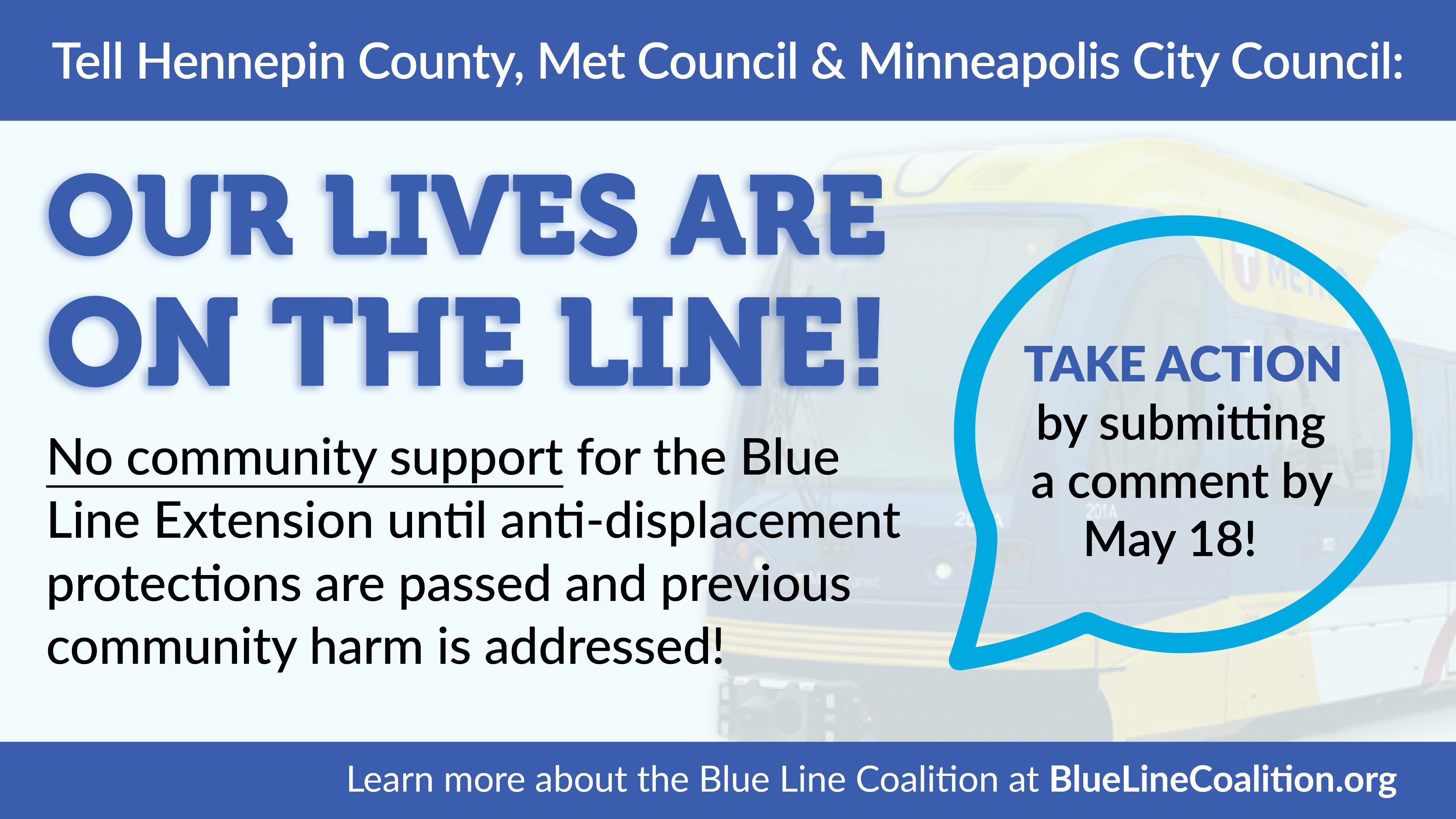
Tell Project Leaders: Stop the Cycle of Transit Displacement!

Click here to send your comment!

Since 2013, the Blue Line Coalition has been working together to make sure government leaders recognize the Blue Line extension project is a racial justice and regional equity issue and that the most directly impacted and marginalized communities must receive the biggest benefits from the massive public investment.

We believe in this project extending the Blue Line light rail from Minneapolis to Brooklyn Park because Black, Indigenous and People of Color (BIPOC) communities have a right to quality transit projects and safety improvements.

But we also know that, even with the best of stated intentions, light rail projects in the Twin Cities and nationwide have pushed the most vulnerable people out of their homes and businesses — over and over and over again. We must stop that cycle of displacement with a different planning approach — one that doesn’t aspire to equitable outcomes but takes the intentional steps at the appropriate time to achieve a different result.

In April, Hennepin County and the Metropolitan Council released their proposed Route Modification Plan, the latest step in a year’s long process and the last step before the project is essentially approved. But once again there are only loose commitments to address community concerns — no solid timeline for the passage of essential protections and community investments before the onslaught of development and displacement pressures begin.

We have seen this before. Years before the train was supposed to break ground, the previously proposed route through Harrison Neighborhood brought development that was unaffordable to local residents and pushed people out. It is incumbent on the project leaders to identify a “community-supported route.”

We say unequivocally that our community does NOT support this route and rejects any further project planning until:

  • Clearly communicated concerns around gentrification are addressed first — not left to 2023 or beyond following the conclusion of a county work group
  • Strong anti-displacement policies are in place — not simply proposed for future adoption without any assurance that those protections will materialize
  • A plan with funding and specific strategies outlined by Harrison Neighborhood Association is in place to repair the harm to the Harrison community — not simply discussed as an unfortunate consequence of previous route planning
  • Significant financial resources are secured to ensure increased ownership and stability for marginalized businesses and residents — not an unmet aspiration left to the political will of future leaders

This is the moment that we can choose to make bold decisions that make this project an example of justice and equity for cities across the nation. We will continue to withhold our support until we, as a community, can be assured that this project will not displace us.

Categories Uncategorized